June 15, 2026

Keeping your eyes healthy by Dr. Stephanie Burris

Common complaints from my patients are often connected to a normal condition of aging. This condition is dry eye syndrome, also known as insufficient tear film.
If you have this condition your ocular symptoms can range from redness, burning, itching, tearing, sandy feeling, and glare sensitivity to even blurred vision. 

The tear film is a moisture layer on the cornea, the most delicate tissue on the surface, which focuses light through into the back of the eye, the retina. When the tear film is not sufficient due to decreased quantity or quality of production, it evaporates quickly, leaving your cornea dry and irritated. If you have a mild form of dry eye syndrome you may only feel symptoms in certain conditions, such as windy, dusty environments or in heated/ air-conditioned buildings. If you have a moderate or severe form of this eye disease, you may feel irritation most of the day even if you are using artificial tear eye drops regularly.

Common causes of insufficient tear film are:
Environment: hot, dry, windy, high altitude, indoor air flow, viewing television/ computer screen
Contact lens wear: contacts absorb moisture from your eyes throughout the day
Medications: decreased tear production possible from oral allergy or blood pressure medications, anti-depressants, or hormone replacement therapy
Systemic Health Conditions: all autoimmune diseases (thyroid, lupus, rosacea, rheumatoid arthritis), diabetes and others
Age: tear production gradually decreases in most people such that at age 65 the tear glands produce less than half of the tears they produced at age 18

Through extensive clinical research it has been determined that the decreased tear production is due to inflammation!  This is, in fact, the root cause of most disease in our bodies. Fortunately there are many ways to manage the symptoms of your dry eye syndrome and even to promote healing of your tear production glands so they can increase natural tear output.
Your treatment may include:

Prescription eye drops to reduce inflammation
Proper type and dosage of artificial tears
Tiny plugs for the tear drainage ducts
Warm eyelid compresses and massage
Oral medication
Oral nutritional supplements such as Omega 3-6-9, vitamin D3
Moisture goggles while sleeping

If you are troubled by the symptoms of dry eye syndrome please see your eye care specialist to discuss the best ways to treat your eyes.

By Dr. Stephanie Burris of Optometry Care Santa Barbara

Ask a Pro by Lisa Wilcox

Question: I’ll be traveling for a few weeks this summer. How do I make sure I don’t lose fitness while on the road? –Amanda from San Francisco

Answer: By Lisa Wilcox. Lisa is the Owner of Pro-Motion Fitness in Santa Barbara, California. She has been working in the fitness industry for 25 years and is a certified Pilates instructor and Posture Alignment Specialist. You can contact Lisa at lisa@promotionfitness.net or www.promotionfitness.net

It’s summer and with summer comes more travel. Whether its road trips or long plane rides, it’s going to be harder to stay with a workout routine. All it takes is a little motivation to fit in a few exercises with absolutely no equipment. Give these travel exercises a try, whether it’s by car, plane or boat.
Get up! Walk up and down the aisles of the plane. Don’t sit for longer than an hour without getting up.
Move your muscles. One of the easiest exercises to do while traveling is heel raises. Lift and lower your heels 10 times. Do two to three sets. This will really get the blood flowing to your whole body and help prevent blood clots to your legs.
Shoulder blade pinches. Sitting up tall in your seat, squeeze your shoulder blades back and down like you are trying to squeeze a broom stick between your shoulders. Squeeze and release 50 times. This exercise wakes up your shoulders and definitely helps with your posture.
Leg squeezes. Place a plastic water bottle, or pillow between your knees. Sit up tall with both feet directly under your knees, roll your pelvis forward and squeeze your inner thighs together, then slowly lift your heels off the floor as if your toes are on egg shells. This is a fantastic exercise for your pelvis and hips. You will be activating your legs and lower back muscles that improve your posture.

Other ideas during your travel would include taking the walking tours versus the bus tour. Seek out the hotel workout room. Take the stairs. Explore new activities that challenge you physically. In your hotel room, lay a towel down on the floor and do push-ups and sit ups.

If the motivation is there no equipment is necessary, just creativity and dedication! Happy traveling and exercising!

Top Tips to Your Performing Edge by JoAnn Dahlkoetter, Ph.D

Want to know how you can create Your Performing Edge and reach your goals faster, easier, and get the results you want? Here are my top tips to help you build new motivation, confidence and major breakthroughs in your training and in your life.
POSITIVE IMAGES: Use your mental images throughout your event or workout to create feelings of speed and power. For example, if you’re walking or running and you come to an unexpected hill visualize a magnet pulling you effortlessly to the top. Use visualization before, during and after your training to build confidence and new motivation.
 POWER WORDS: Make positive self-statements continually. Be aware of your negative thoughts early on. Don’t fight with them; simply acknowledge their presence, and then substitute positive power words. For example, when you’re thinking: “This hurts too much,” say to yourself: “This feeling is connected with getting healthier and doing my absolute best.”
PRESENT FOCUS: Practice being in the present moment. Be Right On – Right Here – Right Now. Remind yourself to stay in the here and now. Let past and future events fade into the background. Remember, the only moment we can do anything about is the one we’re in right now.
ADVANTAGE: Use everything in the workout to your advantage. For example, if another person passes you, tuck in behind and go with his or her energy for as long as possible. You may catch a second wind and be carried on to a personal record.
CHUNKING-GOALS: Focus on your immediate target. Break your training goals down into small, manageable pieces and begin to focus only on the first portion, not the entire workout. For example, say to yourself: “I’m just relaxing and getting my rhythm during the first mile, or the first workout session.”
 
And to get FREE instant access to Dr. Dahlkoetter’s Private Mentoring Program with Your Performing Edge coaching tips, video training, articles and visualization exercises, join her community at:  http://www.PeakPerformancePlan.com. Dr. JoAnn Dahlkoetter, is CEO of Performing Edge Coaching International Association, (http://www.PerformingEdgeCoach.com ) a global resource and Certification Training Program for coaches, and founder of  http://www.DrJoAnn.com  the premiere sports psychology resource for athletes, coaches and sports parents. Dr. JoAnn is best-selling author of YOUR PERFORMING EDGE™, (http://www.sports-psych.com )  on OPRAH and NBC-TV, Stanford Performance Consultant, sports psychologist to OLYMPIC Gold Medalists and CEOs, winner of the San Francisco Marathon and 2nd in the World Championship Hawaii Ironman Triathlon. She is Host of the internationally syndicated TV Show – “Your Performing Edge”, an internationally recognized Keynote Speaker, columnist, and TV expert commentator.  Dr. JoAnn provides sports psychology, mental training and Performing Edge Coach Certification programs for coaches, parents and young athletes to reach their highest potential in sports and life. Call 650-654-5500 to apply for your FREE peak performance consultation. FREE Private Mentoring program at http://www.PeakPerformancePlan.com

Stress-Relief in a Bag by Nicole Clancy

Ever feel so overwhelmed that you can’t even think straight? Planning an outing with a little one takes exactly that…planning! Three experts share their user-friendly, everyday child care tips for insuring we have all we need… in one bag. A little pre-planning allows moms and dads to travel about town with greater ease, and less stress. These simple tips will feed your little one’s mind, challenge their body and invigorate their spirit.
Balance it. Barbara Bushman, PhD Professor at Missouri State University and Fellow of the American College of Sports Medicine, recommends packing a bean bag or two for every day outings. They are a light-weight and portable choice for an entertaining toy on-the-run. “Balancing the bag on top of his/her head and standing with both feet together, or placing the bag on the floor and hopping over it offer a coordination challenge guaranteed to keep your little one interested.” Dr. Bushman says. She adds “bean bags provide control and safety, whereas a ball can roll away.”
The beeper rules. Eliminate the struggle of when to say when, by trying this trick from Brett Klika, Director of Athletics at Fitness Quest 10 and author/researcher of children and athletics. Pick up a child friendly watch at your local convenience store, and show him/her how to fasten about the wrist. Set the countdown timer at ten minutes to go. “Setting the timer gives the child an objective boundary for certain behavior.” He further explains, “your child will learn to value time and since they have the watch, feel as though they have more control or input.” Klika continues, “this process removes the power-struggle and places time accountability in their hands,” The result is no tears, no dreaded melt-downs and no more negotiations.
Game on. Stashing a deck of cards in your bag provides fun memory or coordination games to distract little ones while running errands. Klika, advises “toss a card in the air and challenge your child to catch it. Or play games with the numbers. For example, “pick two cards and calculate the sum of the two numbers.” He continues, “or choose a few cards and challenge them to remember the order.” Your imagination is the limit to activities using a deck of cards.
Fun with Bubbles. Pack a small container of bubbles to help focus your little one’s energy. Jan Schroeder, PhD Department of Kinesiology at Cal State University Long Beach recommends, “alternate blowing bubbles and chasing them across the lawn.” Counting or adding bubbles as they appear and then subtracting as they pop is another fun option to provide practice learning numbers. Focusing energy and attention on a physical or mental activity will provide a welcome distraction while waiting for an appointment.

Attacking Clutter by Juli Shulem

According to the American Demographic Society, Americans waste more than 9 million hours each day looking for lost and misplaced items. Cleaning professionals say that getting rid of excess clutter would eliminate 40% of the housework in an average home. And about 80% of the clutter in your home is a result of disorganization, not lack of space. It would make sense then, to begin by organizing your living and working environments, particularly if your office happens to be in your home.
Start by making a list of all the areas needing work. Just making this list and putting it on paper where you can look at it and acknowledge it usually starts the ball rolling. And where, you might ask, does the “ball” start its roll from? THE MESSIEST PLACE ON YOUR LIST! Why the messiest? It’s the place which grates on your nerves the most and the place which, once organized, will give you the greatest sense of satisfaction.
Here are 5 tips to get started:
Prioritize. Start by going through the space and focus on getting rid of unused, unwanted, and useless items FIRST.  This will give you some clarity immediately and allow you to see what you have left that you may wish to actually hold onto.
Downsize. During the process of purging refrain from shopping and adding to the clutter thinking that more things will help you get better organized. Stay on track with REMOVING items and that’s all.
Organize. As a regular practice take a few extra minutes to put things away in their proper places rather than shove them into the nearest place just to get them out of the way.
Eliminate extras. Get rid of extraneous things lying around the house. These items constantly remind you of another insipid task you didn’t do yet. If you have an item you need to return, just put in it a bag along with others and put the bag in the car, now.
Return borrowed items to their owners. Be careful not to borrow items if you are prone to damaging or losing things in general. You will then end up needing to replace the item, or worse, learn that it is irreplaceable. After you have returned something, you can stop thinking about it, nor will you need to find a place to store the item!

Excerpted and modified from Order! A Logical Approach to an Organized Way of Life. To order the ebook go to www.getordernow.com. Juli Shulem has been an Organizer/ADHD Coach, Efficiency Expert since 1984. She is also the author of Home-Based Business Mom, A Guide to Organizing for the Working Woman. Contact Juli at www.julishulem.com or jshulem@gmail.com.

A Total Body Approach by Nicole Clancy

Research published in March in the ACSM Medicine and Science in Sports and Exercise Journal, confirms the most effective treatment for those with osteoarthritis in the knee should include improving total function for the entire lower body, not just the affected knee. It is projected that by 2020, nearly 57% of the adult population may have this disease. Osteoarthritis not only causes pain and joint limitations, but increases the risk for falling as well.

The study examined movement patterns specific to climbing and descending stairs of those with knee osteoarthritis. Researchers found compensation patterns involving the hip and the ankle, in addition to the knee itself. They concluded an exercise program for those with knee osteoarthritis should include range of motion, balance and strength exercises for the hip, knee and ankle. Here are a few ideas to get started:

Standing straight leg forward and backward hip range of motion. Stand on your right leg. Keep your left knee straight and move your left leg about six inches forward and six inches behind you. Perform 5-8 times. Repeat standing on your left leg; move your right leg forward and back 5-8 times.

One leg hold for balance. Hold on to a stable object. Stand on your right leg only for 10 seconds. Repeat by standing on your left leg only for 10 seconds.

Standing heel raises for strength.Stand with your feet hip-width apart and hold on to a stable object for safety. Lift both heels about 2 inches off the ground, and then slowly lower only about an inch. Perform 10 times.

Ankle range of motion.Stand on your right leg. Extend your left leg forward about six inches with your knee straight, circle your ankle 5 times to the right and 5 times to the left. Repeat standing on your left leg; extend your right leg forward and circle your right ankle 5 times to the right and 5 times to the left.

Nicole Clancy has been a freelance writer and certified fitness professional since 1990. She’s contributed to Body and Soul, SELF, Redbook, Prevention, Her Sports, Good Housekeeping, Girls Life, Triathlete Magazine, Santa Barbara Magazine and Woman Magazine, as well as various health/fitness trade publications. Her articles have been internationally syndicated in Vogue, Glamour and Easy Living.

Revisit Childhood by Pete McCall

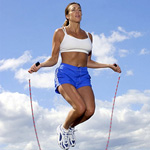
Bring back the play-days of childhood with this simple go-to get fit quick cardio option! According to Pete McCall, Exercise Physiologist at the American Council on Exercise, a simple cardio choice for calorie burning and heart conditioning is jumping rope. With the purchase price of $10 to $20.00, a standard jump rope can be found at just about every sporting supply store.

“Jumping rope is provides a similar cardio respiratory benefit to running, but doesn’t require having to go outside in inclement weather or in unfamiliar territory.” They are ideal to use while traveling to maintain fitness, as well as when we find ourselves tight on space or time.  “Jump ropes are totally portable and can be used anywhere as an effective means of cardio training and burning calories.” Pete adds.

Jumping rope can also take our cardio fitness to the next level through total body toning. Kick your workout up a notch and burn up to 700 calories per hour without even leaving your living room. How to begin: start with 20 second count of jumping, followed by 20-30 second recovery period of walking around the room. Perform 3 cycles, followed by a 2 minute rest period of walking slowly. As endurance improves, extend the duration of the jumping interval to one minute, then two minutes and so on. Adding in a higher intensity recovery activity such as jogging in place or walking lunges will also ramp up calorie burning and toning.

Ask a Pro By Erin A. McGill, MA, NASM CPT, CES, PES

Question:
If I’m short of time, should I do weight training or cardio?  – Barbara from San Diego

Answer:
By Erin A. McGill, MA, NASM CPT, CES, PES. Erin is the Training Manager for National Academy of Sports Medicine.

If you are short on time, you can maximize your minutes in the gym by doing a circuit training workout. Circuit training is a type of resistance (weight) training where you perform sets of exercises one right after another with little to no rest. You will perform one set of each exercise until all exercises have been completed and then you begin your second round.  If you have the time, performing three full cycles of the circuit will be most helpful. An example of a circuit could be 12 – 20 repetitions of each exercise and a total of three circuits.

This type of workout is helpful because it allows you to capture two important benefits. If weight loss is your goal, weight training is very effective because you burn calories while you are performing the exercises but also for the next 24 – 48 hours after the workout. Additionally, performing resistance training will allow you to increase your lean body mass which will result in an increased caloric burn 24 hours per day.

Because circuit training involves performing the sets in rapid succession, one right after another, cardio respiratory benefits exist as well. Working out with no rest in between sets will tax both the cardiovascular and respiratory systems in a fashion that is very similar to traditional cardio training sessions. With that being said, your caloric burn is maximized in the workout.

Creating an Inner Desire by JoAnn Dahlkoetter, Ph.D.

To excel as a top performer you must be hungry- hungry for success, for results – hungry simply to become the best athlete you can be. It starts with a dream, but somehow you must be inspired, or you will never be able to reach your goal.

What are the key characteristics of well-motivated athletes? Through my extensive work with numerous athletes over several years, I have developed a constellation of traits that defines the champion’s mentality. Elite athletes do not possess superhuman powers or extraordinary qualifications limited to a selected few. The characteristics that make a champion can be attained and developed by ANYONE who wants to excel in a sport:

Enthusiasm and Desire - Love for Your Sport: Top athletes have a hunger, a fire inside which fuels their passion to achieve an important goal, regardless of their level of talent or ability. To accomplish anything of value in life you need to begin with some kind of vision or dream.  The more clearly you can see that picture in your mind, the more likely it is to become reality.  Wherever you place your attention, your energy will follow.

Courage to Succeed - Once an athlete has the desire, he or she needs to back it up with courage – the incentive to make any dream you dare to dream become reality.  It takes courage to sacrifice, to work out when you’re tired, to seek out tough competition when you know you’ll probably lose.  It takes courage to stick to your game plan and the relentless pursuit of your goal when you encounter obstacles.  It takes courage to push yourself to places that you have never been before – physically or mentally. It takes courage to test your limits, and to break through barriers.

Internal motivation and self-direction - Champion athletes decide early on that they are training and competing for themselves, not for their parents, their coaches, or for the medals. Direction and drive need to come from within.  The goals must be ones that you have chosen because that’s exactly what you want to be doing.  Ask yourself, what keeps you running? Who are you doing it for?

Commitment to Excellence - How good do you want to be?  Elite athletes know that to excel at their sport, they must decide to make it a priority in their life.  They make an honest effort each day to be the best at what they do.  At some point you must say, I want to be really good at this; I want this to work.  To notice significant growth you must live this commitment and regularly stretch what you perceive to be your current limits.

Discipline, Consistency, Organization - Winning athletes know how to self-energize and work hard on a daily basis. Because they love what they do it is easier for them to maintain consistency in training and in competing. Regardless of personal problems, fatigue, or difficult circumstances, they can generate the optimal amount of excitement and energy to do their best.

Being focused and yet relaxed - Champions have the ability to maintain concentration for long periods of time.  They can tune in what’s critical to their performance and tune out what’s not.  They can easily let go of distractions and take control of their attention.
Ability to handle adversity:  Top athletes know how to deal with difficult situations. Adversity builds character.  When elite athletes know the odds are against them they embrace the chance to explore the outer limits of their potential.  Rather than avoiding pressure they feel challenged by it. They are calm and relaxed under fire. Setbacks become an opportunity for learning; they open the way for deep personal growth.

Dr. JoAnn Dahlkoetter , at www.DrJoAnn.com best-selling author of YOUR PERFORMING EDGE™, on OPRAH and NBC-TV, is CEO of Performing Edge Coaching International Association,  (www.PerformingEdgeCoach.com)  Stanford Performance Consultant, sports psychologist to OLYMPIC Gold Medalists and CEOs, winner of the San Francisco Marathon and 2nd in the World Championship Hawaii Ironman Triathlon. She is Host of the internationally syndicated TV Show, “Your Performing Edge”,  a renown Keynote Speaker, columnist, and TV expert commentator.

Dr. JoAnn provides corporate training and Performing Edge Coach programs for sports, business, wellness, to reach your highest potential life.  FREE Book chapter at:   http://sports-psych.com/book_order.html

To download Dr. Dahlkoetter’s FREE Private Mentoring Program to reach Your Performing Edge with coaching, video training tips and valuable articles at: www.drjoann.com/2009/12/tips/ ,  or for your Custom Peak Performance Visualization MP3 Audio made personally for you, call 650-654-5500.   www.DrJoAnn.com.

A Successful Summer by Niels Johnson-Lameijer

Motivate, breakdown and celebrate.

The season of summer fun has started, so how can we maintain, and even increase our motivation when the sun keeps calling us out to play? Having a strong commitment to our end desired result is a key component to ultimately realizing a goal or dream. Goals give us direction and add meaning to our lives. Even though it is important to think big when crafting goals, a target too far out of your reach can end up becoming paralyzing and discouraging. Here’s how to do it right:

The first step to motivation is to simply set a goal. What do you want to accomplish? Each one of us approaches realizing our goals differently. Some dive into it head first; some plan extensively and proceed with caution. Write your goal down, details and all!
The second step is to believe that the ultimate goal is achievable! Based on this belief, ask, “what can I do today (or this week) that gets me closer to my goal?” The answer to this question will help breakdown the larger goal into smaller more tangible targets to accomplish in the very near future. Marking these smaller tasks off your to-do list will give you a feeling of accomplishment and will move you closer to your long term goal. When jotting down the smaller action steps, make sure that the list is manageable. Make it easy and accessible to insure that by the end of the day you are able to mark things off. This will create momentum, so add some to-do’s that you know you will easily achieve.

The final piece of the motivation puzzle is to CELEBRATE! At the end of each day, write down successes you achieved that day. Write down at least three every day, no exceptions, and celebrate them!

Niels is an internationally certified Corporate Coach and Life Mastery Coach. He guides passionate individuals to raise productivity and realize the life of their dreams, both in a corporate and private environment. For more information, visit www.nielsjl.com or email Niels at niels@nielsjl.com or call 805-617-3513.