March 8, 2026

Be a Beginner…Again by Nicole Bryan

In a workout slump? One of the best ways to increase motivation is to try a new activity. For many, merely the thought of being the new kid in class conjures up uncomfortable feelings and images of being lost or not performing correctly. However, as adults, we are in charge of how we can approach a new activity with confidence, humility and yes, even a sense of humor.

If you’ve been in the fitness world for a while, you may have forgotten what it feels like to be a beginner. Consider it! You may even find a new sport, workout or physical activity to love. If you’ve been thinking of trying a new exercise, make TODAY the day you become a beginner, yet again. Go ahead, get comfortable with being uncomfortable. I dare you!

Here’s how to make being a beginner a little less scary:

Talk to friends. Actually, talk to everyone and anyone you know who has participated in the activity you are considering. As them what they like and don’t like about the activity. Ask them what location, instructor, gear and technique they recommend. Also, ask what initial fitness capabilities are required.

Google it. Let’s face it, we’re no longer in a not-knowing age of technology. Simply do a search online. Play connect-the-dots with the information you find, and see where it leads you.

Request a guest pass. If you’re unsure if you’ll like the activity, save some money up front by asking for a guest pass. Many facilities and even instructors allow a first-visit-free opportunity. You’ll never know if there are discounts or free trials available unless you ask!

Try and try again. Instead of discounting the new activity right off the bat after a unpleasant experience, give it at least three attempts on three different days. Sometimes it’s a matter of finding a the right fit of location, instructor personality or class participants.

Learning takes time! You didn’t just walk on to the tennis court the first time and score an ace, so why would you expect to instantly master the skills needed during your first try? Learning is half the fun after all! Cut yourself a break, and remind yourself that learning a new activity takes time.
Teen Fitness 101 by Jennifer Austin

School’s back in session. Why not take the opportunity to start talking about fitness with your youngster. Encourage them to learn the proper principles through a professional, instead of through gossip and fads. Invite their friends to join in on setting up healthy behaviors for a lifetime. Although they’ll probably never admit it, as they grow up they’ll appreciate knowing how to separate the facts of fitness, from the fiction of what they may see and hear.

Stay engaged with your teen to manage their activity by keeping a few points in mind:

Invest in professional instruction. Private instruction, community class or sport clubs will provide the basic principles of fitness.

Designate a space. Whether it’s a space in the garage, a corner of the room or shared living space, designate the area as the gym.

Allow their creativity. Posters, music and having a say in the location of the workout space will empower teens to want to make the effort to participate.

Base principles on science. Many mixed messages exist in the media and it’s only natural for young people to confuse what they read, see and hear with the facts of physiology.

Praise efforts. Anytime active time is better than inactive time!

Preach balanced behavior. Being mindful of words and attitude toward wellness will go a long way to establishing and setting a healthy example.

Listen. What kinds of statements are you hearing from your youngster regarding health and fitness. Don’t let mumbles or words during a quick passing of self-doubt or low self-esteem go unnoticed.

Get Extra Credit from your Walking Workout by Nicole Bryan

Looking to increase the intensity of your walking workout? Add in a few extra credit moves to burn additional calories. (Always consult your doctor before beginning exercise. The following is for those without injury or illness concerns.)

Walking Lunges. At the end of your walk, perform one to three sets of walking lunges. Step forward about three feet with your right foot. Bend your left knee and lower it about twelve inches toward the floor; bend your right knee so it is directly over your right ankle. Then transfer your weight forward onto your right foot, lift your left foot and swing your left foot to the center, then forward about three feet. Bend your right knee and lower it about twelve inches toward the floor; bend your left knee so it is directly over your ankle. Repeat ten times. For more of a challenge, increase the range of motion of lowering the knee towards the floor. Lower down until your knee is about two inches off the floor.

Standing Calf Raises. At the end of your walk, perform one to three sets of calf raises. Stand facing the curb or a step. Hang your heels off the curb. Lift and lower your heels. Perform ten to fifteen repetitions. For more of a challenge, place both arms across your chest when lifting and lowering your heels. Doing so will add a balance challenge into your calf raises.

Wall Squats. At various intervals during your walk, find a place to perform a wall squat hold. Position your feet about three-feet away from the wall and lean with your back against a wall or secure post. Slide your body down the wall until your thighs are parallel to the floor, keeping your knees directly over your ankles. Hold this position for ten to thirty seconds. Perform two to three sets back to back with thirty seconds rest in between holds. For more of a challenge, while in the wall squat position, keep your torso upright and still and lift your right foot about six inches off the ground and hold for ten to thirty seconds. Return your right foot to the floor and then lift your left foot about six inches off the ground for a hold of ten to thirty seconds. Perform two to three sets with each foot.

Walking Pick ups. Choose different landmarks on your route, or at specific time or mileage intervals do a quick pick-up of your walking pace for two to three minutes. During the pick up interval, shorten your stride, focus on the turnover of your legs, and move your arms. For more of a challenge, decrease the rest time in between intervals to thirty seconds of walking. Then go right back into another pick up interval.

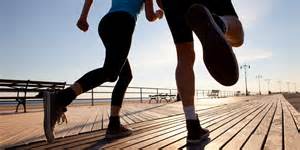
Jogging Intervals. At each mile, do a short thirty second to two minute jogging interval. Extend the duration of your intervals to increase the intensity of your workout.

Stair climb. Find a flight of stairs on your walking route and do a few quick intervals up and down. To ramp up intensity, take the steps two at a time on the ascent and jog the descent.


*Disclaimer: Result may vary from person to person.


Hot Climate Exercise by Mathew Ireland

Training outdoors in hot temps is not all sunshine and roses; exercising in the heat can also cause problems!

Hydration

Firstly, I don’t want to bore you by telling you to stay hydrated. We all know the health risks. What I will say is why it is important to stay hydrated when training. Dehydration is not only seriously bad for your health, it also has a negative impact on your training. Studies suggest that to get the most out of your workout, your body needs to be adequately hydrated. This is the case for all types of training, from cardio to strength training.

Another risk when training in hot climates is heat cramp. Heat cramps can easily stop you exercising. They can also be prevented, by maintaining a balance of water and sodium (salt) in your diet.

Acclimatization

Many people may overlook this but your body needs to adjust to the heat. In order to acclimatize, you should increase intensity and duration in the heat over time (typically between 3 days and 2 weeks, depending on the individual). Acclimatization can provide many benefits including earlier sweating to keep cool, and less sodium lost with sweat.

Clothing

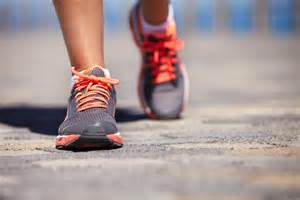
You should wear loose, light-colored clothing, which is designed to promote cooling. It’s also worth thinking about your footwear. Training shoes that ‘breathe’ will help keep your feet cool.

Skin Care

Once again, using sun cream in radiant heat should be obvious. Sunburn is uncomfortable and can stop you from training. Always protect your skin.

After Exercise

Replacing any water or electrolytes after exercise is important, especially for recovery. With adequate time, electrolytes will be replaced by a balanced diet but can also be replaced with specific sports drinks. It is important to note that if you are working out for less than an hour, you shouldn’t need an electrolyte drink. They are designed for use after longer periods of exercise.

Using this advice, plan your workouts in advance to get the most out of your training.

Mathew Ireland is the founder and a regular writer for Fitness Cumbria – an online magazine delivering health and fitness information to the Cumbrian population. He trains clients over the county, and focuses on outdoor and body-weight training.


At-Your-Office Stretching by Jennifer Austin

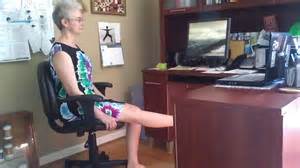
If you’re sitting at your desk all day and find that neck, back and leg aches are a part of your every day, there is a solution. Combining range of motion, stretching and deep breathing will reduce muscle tension, as well as release stress. Use each series below as your check list and simply follow as outlined moving from one exercise to the next. Stretching and range of motion exercises should never be painful. Ease into each exercise and start slowly. The following stretch and range of motion exercises are for those without injury or illness concerns. Consult your physician before beginning exercises.

To decrease low back tension:
Lift both heels 10 times. Lift your toes 10 times. Circle your right ankle 10 times. Then circle your left ankle 10 times. Extend and bend your right knee 5 times, extend and bend your left knee 5 times. Lift and lower your knees as in seated marching 10 times total. Keeping your torso upright, inhale and cross your right ankle over your left knee. Exhale and pull your right knee in toward your chest and hold for 10 seconds. Release this stretch. Inhale and place your left ankle over your right knee. Exhale and pull your left knee in toward your chest and hold for 10 seconds. Release. Inhale and lift your right knee straight up toward your chest. Exhale and hold for 10 seconds. Release your right knee back down to the floor. Inhale while pulling your left knee up toward your chest. Exhale and hold this position for 10 seconds. Release this stretch. Drop your chin to your chest and place both hands in your lap. Next inhale and “walk” your hands down your legs toward the floor. Exhale and “walk” your hands back up your legs to your lap to return to your seated upright position with your shoulders down and back.

To ease neck tension:
Inhale and shrug both shoulders up. Exhale and slowly pull your shoulders down and back. Repeat 5 times. Circle both wrists 5 times each direction. Inhale and reach both arms straight up overhead. Exhale and lean to the right, then lean to the left. Repeat 5 times. Inhale and lace your fingers behind your head. Exhale and pull your shoulders down and your elbows wide. Hold for 10 seconds. Release and lower your arms. Keeping your torso upright, inhale and drop your chin down toward your chest. Exhale and reach both arms out wide to the side of your body. Release your arms to the side of your body. Inhale pinch your shoulder blades together, exhale and release; repeat 5 times. Inhale and drop your right ear toward your right shoulder. Exhale and drop your left ear to your left shoulder. Inhale and lace your fingers behind your body, pinch your shoulder blades together and extend your arms. Exhale and push your hands toward the floor; hold for 10 seconds.
 

Why weight training could change how you workout forever! By Kaitlin Cofer

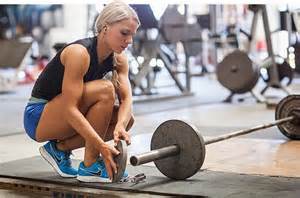
In years past, weight training has been viewed as a bodybuilder’s activity, a thing that “meat heads” do. But, thanks to the growing popularity of weight lifting and circuit training, iron isn’t just something you consume anymore.

You may be asking, how can weight training change how you workout forever? Here are 3 key reasons that weight training is effective and will keep you interested in working out for years to come. Always consult your physician before beginning exercise.


1. Involving weights in your workout causes your muscles to work harder which in return increases your metabolism and burns more calories as well as increases bone health. 


Example: Add in some dumbbell work to your normal circuit and you will feel your muscles burning faster than if you did the exercise with body weight alone.


2. There are countless exercises that involve weights! Back squats with a straight bar, squats with dumbbells, squats with plated weights…the number of exercises that you can do with weights and the exercises that can be changed up by adding different types of weights is countless.


Example workout using Dumbbells: 


5 Rounds of 50 seconds work and 10 seconds rest: (Always consult your physician before beginning exercise.)


1. Dumbbell push press: hold dumbbells with palms facing out and slightly dip your body down with a slight knee bend and use that momentum to drive the dumbbells up to the sky and back down, repeat this movement for 50 seconds.


2. Renegade rows with dumbbells: place dumbbells on the ground and get into a push up position while holding the dumbbells. Push up and bring up one dumbbell at a time, repeat for 50 seconds. *modification=push ups from knees.


3. Single arm row with dumbbells: stand up with one dumbbell in hand. Stagger your legs into a lunge like position. Place the hand without the dumbbell on your thigh and keep your core engaged and back straight. Row the dumbbell back with your elbow bent and jabbing the air behind you. Repeat on opposite side.


All four of these workouts incorporate weights, causing each move to be a total body exercise.


3. Three words: Strong is SEXY!

A male or female with muscles is sexy. There is nothing more attractive than a person who looks and feels strong. A healthy body is a healthy mind.


No matter if you belong to a large gym, a circuit training center or you have your own set of weights at home, it is easy, fun, and effective to add weights to your routine! Start light and work your way up!


Kaitlin earned a B.S. Nutrition from Cal Poly SLO and is a CPT. Kaitlin’s extremely passionate about inspiring people to find/fuel their inner athlete.

*Disclaimer: Result may vary from person to person.


No time to workout? By Nicole Bryan

Short on time? Instead of trying to create extra time to fit exercise into your schedule, try allowing your current schedule to dictate your cardiovascular and strength training exercise. Use the time you already have! Exercise is cumulative; it all adds up to a healthier heart, leaner waistline, strong muscles, improved agility and a peaceful mind. Consult a physician before beginning or performing any exercise.

If you have 2 minutes: Change your position! If you’re sitting, stand up. If you’re standing, walk. If you’re walking, climb a flight of stairs. Move differently often to improve circulation, decrease soreness and improve energy and mood.

If you have 5 minutes: Stand up. Perform 20 posture squats: Stand with your feet hip-width apart. Extend both arms straight out in front of you with your arms straight and hold them parallel to the floor. Sit back, bend from your knees and hips and lower your body until your thighs are about parallel to the floor. Return to your starting position. Next do 10 Pushups.  Follow Pushups with a 30 second Plank interval on your forearms and toes: Place your forearms on the floor, with your elbows directly below your shoulders. Place your toes on the floor and hold the center of your body up parallel to the floor, and count to 30. Repeat 2-3 times through. Move from one exercise to the next without a rest interval.

If you have 10 minutes: Walk down the street 4 minutes. At the end of the block, do 20 Heel Raises: Stand with your feet hip-width apart, place your arms across your chest using your core muscles to balance and stabilize your body. Lift up your heels, and then lower your heels half way down the floor. Walk back to your starting point. Do a Wall Squat Hold for 30 seconds: Lean with your back against a wall and your feet about 12 inches away from the wall. Lower your body down about six inches. Hold for a count of 30. Return to your standing upright position.

If you have 15 minutes: Perform a walking warm-up for 5 minutes. Begin body-weight exercises with 20 Squats: Place your arms across your chest. Stand with your feet hip-width apart. Bend your knees and hips and sit back, lowering your body about twelve inches. Return to your starting position. Move on to 10 Wall Pushups: Place your hands shoulder width and shoulder level on the wall. Bending from your elbows, lower your chest toward the wall, then straighten your arms again to return to your starting position. Immediately from Wall Pushups, perform 10 Jump Squats: Squat down, then upon standing, jump up lifting both feet off the floor and raising both arms overhead. Land gently and lower your body down into a squat.  Repeat Squats, Wall Pushups, and Jump Squats three times through with no rest in between.


*Disclaimer: Result may vary from person to person.


Are you having FUN?

YES, your fitness should be FUN!

Laugh, run, play, act silly. Why? Because it’s FUN and having fun is motivating! If you’re not enjoying your workout (at least most of the time), change it!

Put the FUN back in your workouts: Join #HealthyWayMag Fitness Chat on Twitter every Monday at 5pm(Pacific)/8pm(Eastern)!

Simply log onto your Twitter account and follow @HealthyWayMag to participate. Questions for discussion will be posted as Question 1, “Q1″, Question 2, “Q2″ and so on. Contribute your answer and experience via answers to Question 1 noted as “A1″, answer to Question 2 as “A2″ and so on.

Interact with others, chat, exchange ideas, training tips and have fun!


Monday August 17, 2015 #HealthyWayMag Fitness Chat Sponsored by Swagtastic Virtual Race:

A virtual race is an organized event held online. The benefits? Participants can join in from all over the country, and you race on your own time and schedule. Join Swagtastic Virtual Race and run or walk to benefit Medals4Mettle, and you’ll receive a swag bag filled with over 20 health, fitness and endurance products! Choose from 5K, 10K, half marathon or marathon and complete your miles between October 9, 2015 and October 12, 2015. Self-track your time and your miles. Virtual races are a great way to connect with fellow fitness enthusiasts, put a goal to your workouts and support a non-profit group all at the same time. Join in the fun on Twitter, @SwagtasticRace. Registration is OPEN!

Back to the Basics by David Hutchings

Train well, eat well, recover well. Follow these three themes and you’ll be on your way to reaching your fitness goals.  Sometimes people get bogged down in the details before getting the basics right.

The information floating around makes it difficult to even identify the basics.

Firstly, nutrition.  Eat for your goal.  It’s that simple (theoretically).  If you want to lose weight, you need to eat fewer calories than you burn. Before you worry about supplements, fat burners or meal timing answer this: are you eating fewer calories than you burn through daily activity?  There are many apps that can tell you the amount of calories you should be eating to lose weight.  They’ll also help you track your food.  Get one and start tracking – then you’ll know whether you’re eating the right amount of calories.

Next, training.  You can lose weight by diet alone, but you’ll also lose muscle along with the fat which isn’t ideal.  This is where training comes in.  Training burns calories, but the right training will minimise muscle loss too.  Doubly beneficial. Having more lean muscle means you burn more calories just going about your daily life.  It also means you’ll have more muscle tone once the fat is burned off.

Lastly, recovery.  Watching your nutrition and training appropriately are vital, so is recovery.  You need rest so the body can prepare itself for the next day of training and eating well. Losing weight is stressful to the body in terms of training and being in a caloric deficit.  It’s also stressful on the mind.  Setbacks are frustrating and can take a toll mentally so ensure you are getting your rest.

If you’re trying to lose weight but haven’t been successful ask yourself this – am I eating, training, and recovering well?  Chances are if one of these boxes isn’t being ticked, it could be the reason.

David Hutchings is the owner of 360 Degree Fitness Limited  — a mobile personal and small group training business based in Wellington, New Zealand. He trains a variety of clients from regular folks trying to get a little fitter to athletes looking to increase their speed and strength. He likes to fish, hang out with his wife and son, and also enjoys classic rock and a good barbecue.


*Disclaimer: Result may vary from person to person.


So you’re ready to start an exercise program? By Jennifer Austin

So you want to start an exercise program? Making the decision to get fit doesn’t have to happen on January 1st, and it doesn’t have to happen on a Monday either, you can decide to get fit…today! So, where do you start? Here are your first five 5 steps to getting fit:

Medical clearance to exercise. If it’s been over a year since you’ve done blood work, do it. If it’s been awhile since you’ve been cleared from all your age-appropriate tests, do them. Blood pressure should be checked, as well as reviewing family history with your doctor.

Start moving daily/take breaks. Any kind of moving is good for your mind and healthy for your body. Start carving out scheduled breaks during your day. Walk out to the mail box, walk around the block, play with the kids.

Get a pedometer to find a starting point. How do you know where to begin if you don’t know your base? Wear your pedometer for one week consistently.

Find a professional. Be sure you’re making every minute count by building structure into your workout. Seek direction from a Fitness Professional to for proper instruction as to how the different systems of your body function. He or she can outline exact steps to safe and effective exercise.

Set goals. Grab a pen and paper. Write down a 3-week goal, 6-week goal, and 3-month goal to start. Beside your first goal, write down your action step to take immediately. Build momentum!